
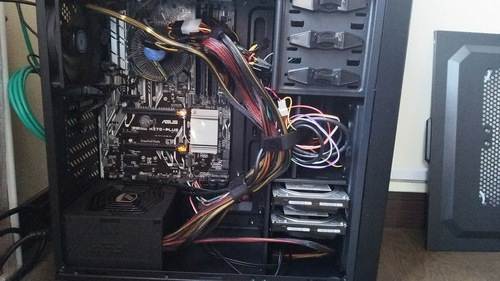
Yesterday, I went back to my parents’ house and upgraded my server to a 4th generation machine.
Since it’s been about 10 years since the last upgrade, there’s been a significant spec boost.
CPU: Sempron 2400+ (1 core) → Pentium G6500 (2 cores & 2 threads)
Memory: 1G → 16G
HDD: 400G×2 → 4T×2
And since the network is now fully gigabit Ethernet,
Upload: From server to internet 300Mbps
Download: From internet to server 150Mbps
is the approximate throughput.
With the old server, there was a bandwidth restriction of 30GB/day from the provider, which might have caused some inconvenience to some users, but perhaps it’s no longer necessary to worry about such small details.
The old server, the third-generation machine, was assembled nine years ago when I became a working adult, and it served me faithfully without a single failure.
Looking at the motherboard, most of the electrolytic capacitors had exploded, and it was in a state where the power could go out at any moment. I want to say, ‘Thank you for your hard work.’
This fourth-generation machine incorporates lessons learned from the third generation:
・A highly durable motherboard.
・A power supply with high power efficiency and stability.
・Adopting HGST-made HDDs, which are reputed for their low failure rate.
These were the criteria. I hope it operates for at least 5 years.
Traditionally, I’ve used the latest OS, Fedora, but it actually had the drawback of a short support period.
This time, while I haven’t changed from the Red Hat family, I’ve adopted CentOS, which has a long support period and is used commercially.
However, I adopted CentOS 7 this time, and the architecture changed significantly between versions 6 and 7, so building it was a struggle.
However, it has many attractive features, such as the virtualization technology KVM, so I want to try out various things.
It’s been 14 years since I started running a home server, and I’m still looking for users who would like to host their homepages.
If you’re interested, please feel free. Given the times, it’s inevitable that it’s a legacy system…